Drafting, Translation, Templates and File Library
Four workspaces sit on the rail below Document Review. Three of them have a single screen; File Library has two sections. None of them has a tab strip except File Library.
Drafting
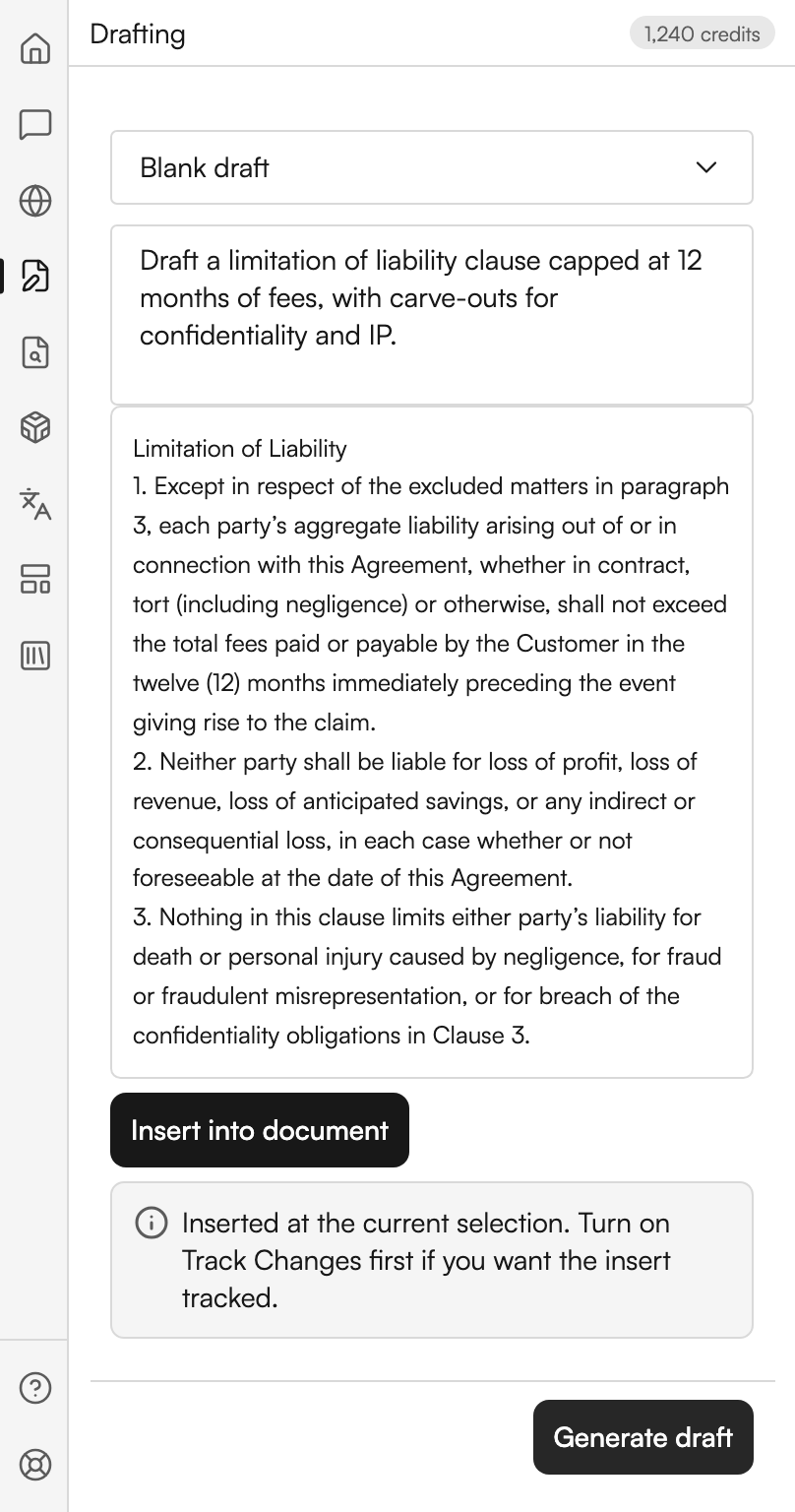
Draft from prompt generates new text and inserts it where your cursor is.
| Control | Where | What it does |
|---|---|---|
| The template dropdown | Top of the panel | Which drafting template to start from. The first option is Blank draft |
| The prompt box | Below it | Placeholdered Describe the clause or agreement to draft… |
| Generate draft | Footer | Starts the run |
| Stop | Replaces Generate draft while running | Ends the run. The panel then reads Stopped. |
| Insert into document | Under the result | Writes the draft in at your cursor |
A prompt that is too short is refused with a message asking you to describe the draft in more characters.
The insert carries a reminder worth reading before you press it: Inserted at the current selection. Turn on Track Changes first if you want the insert tracked. Judicio does not switch Track Changes on for you here.
The template list is the same one you use in the web app. See Drafting templates.
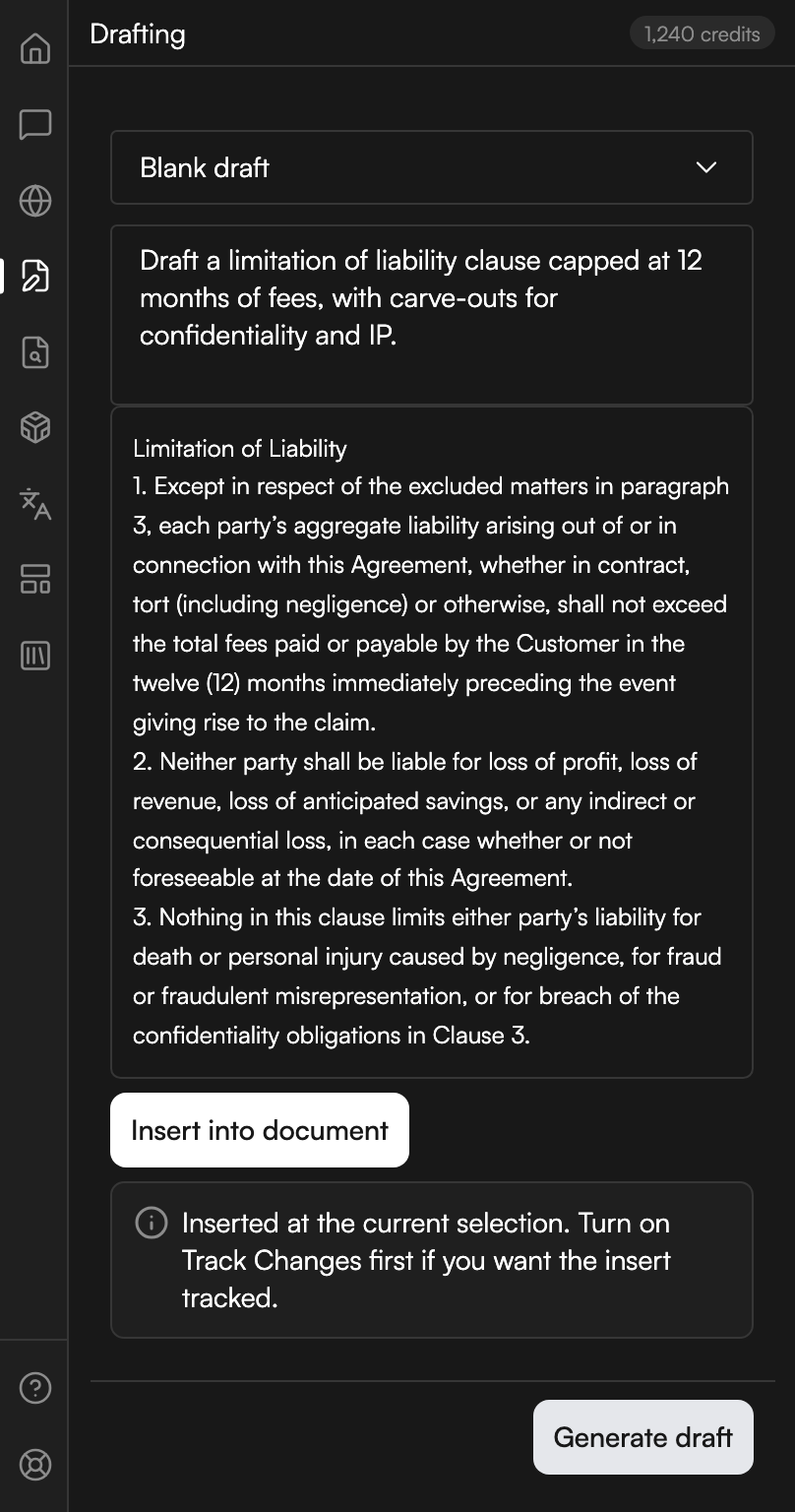
A generated clause, ready to insert
A clause drafted from a prompt, with the Track Changes reminder under the insert button.
Translation
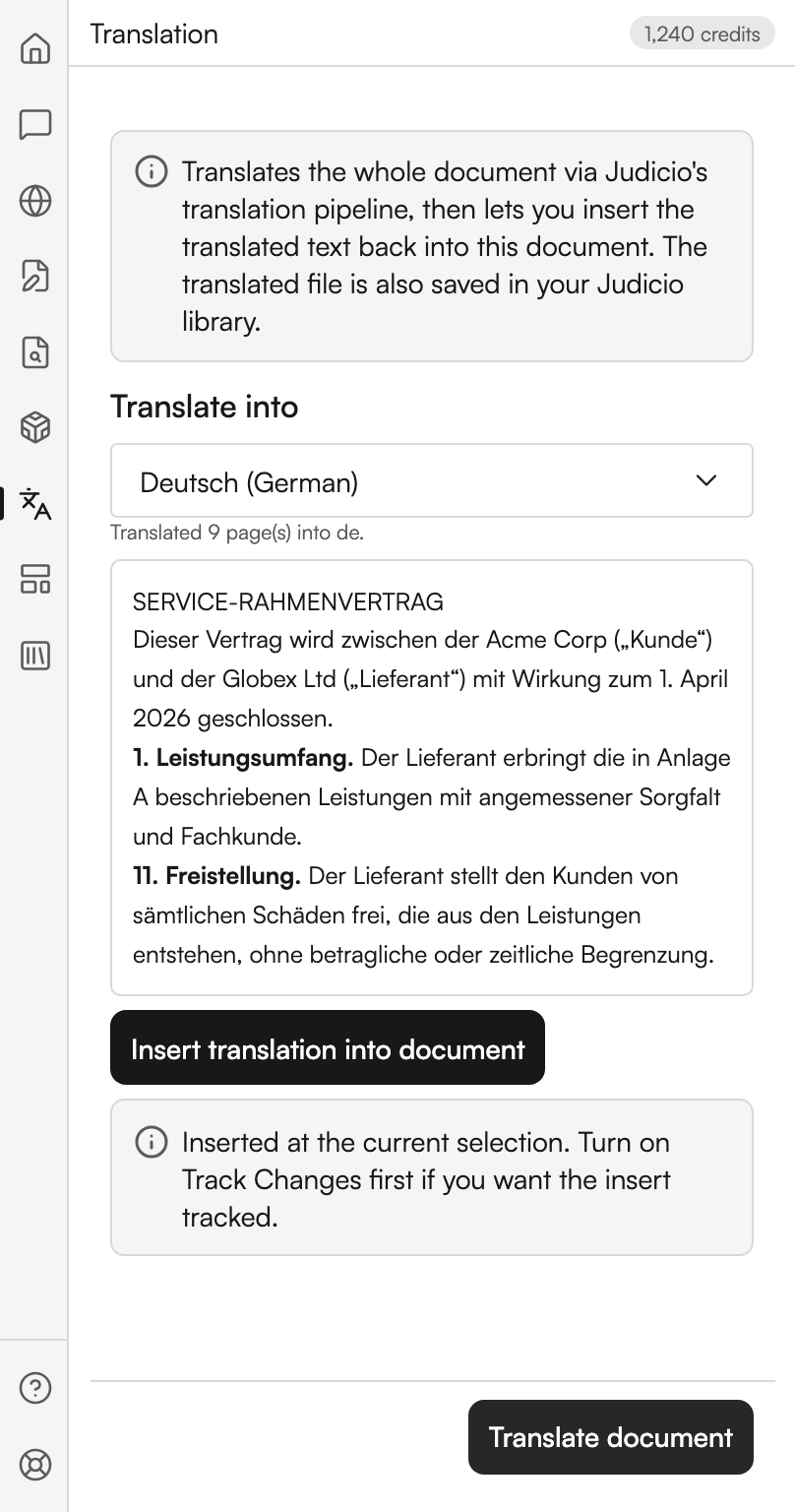
Translate document runs the whole file through Judicio's translation pipeline. Its note says: Translates the whole document via Judicio's translation pipeline, then lets you insert the translated text back into this document. The translated file is also saved in your Judicio library.
| Control | Where | What it does |
|---|---|---|
| Translate into | A searchable dropdown | The target language. It has a Search languages box and reports when nothing matches |
| Translate document | Footer | Starts the run |
| Insert translation into document | Under the result | Places the translated text |
While it runs the panel reports progress, starting at Starting translation… and then Translating…. When it finishes it says how many pages it translated and into which language.
The insert replaces your selection if you have one, and lands after the selection otherwise; the panel tells you which happened. The same Track Changes reminder applies: turn it on first if you want the insert tracked.
The translated file is saved into your Judicio library as well, so it is available in the web app. See Translation.
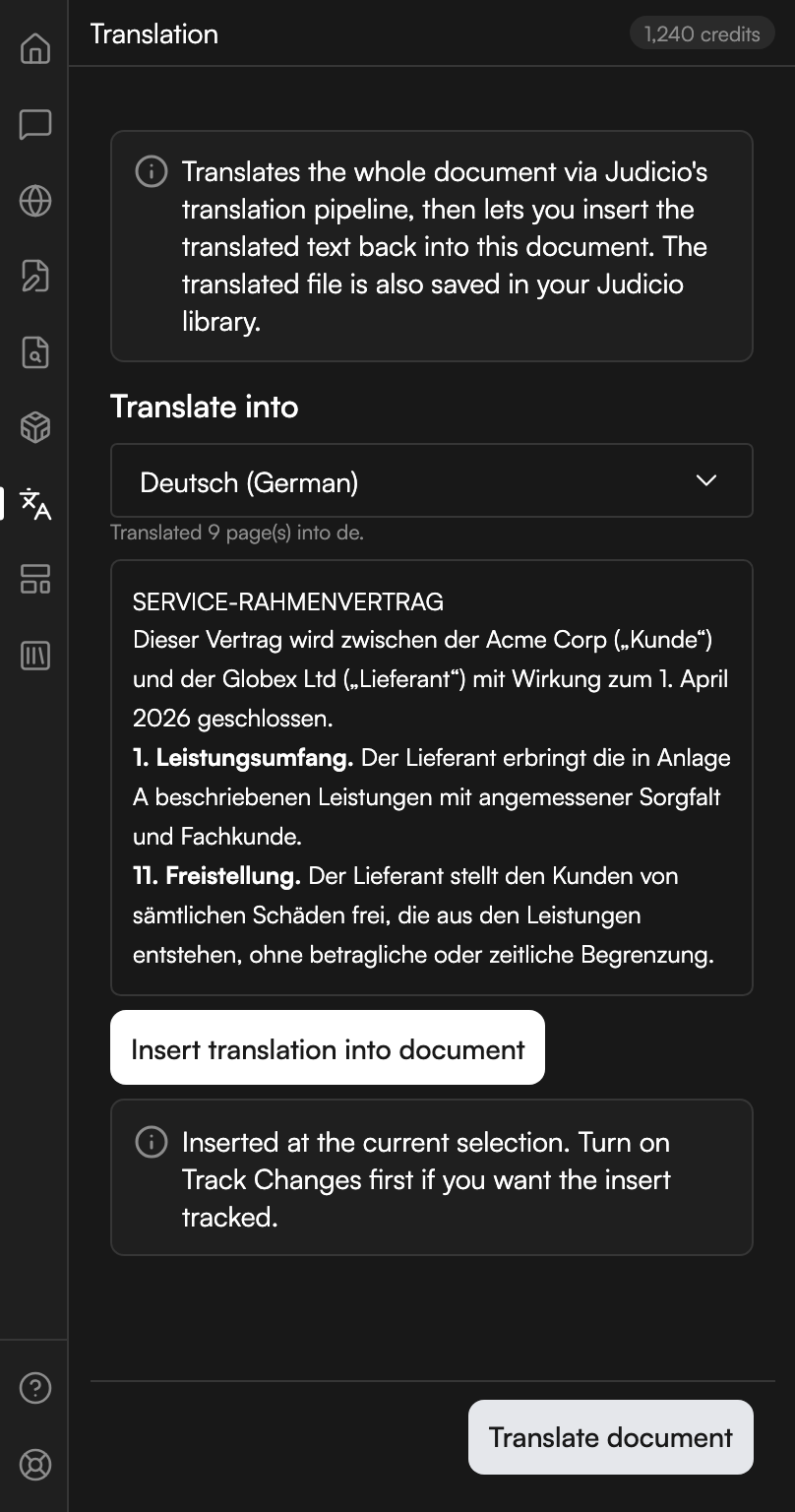
A translated document
The target language chosen and the translation returned, with the insert action beneath it.
Templates
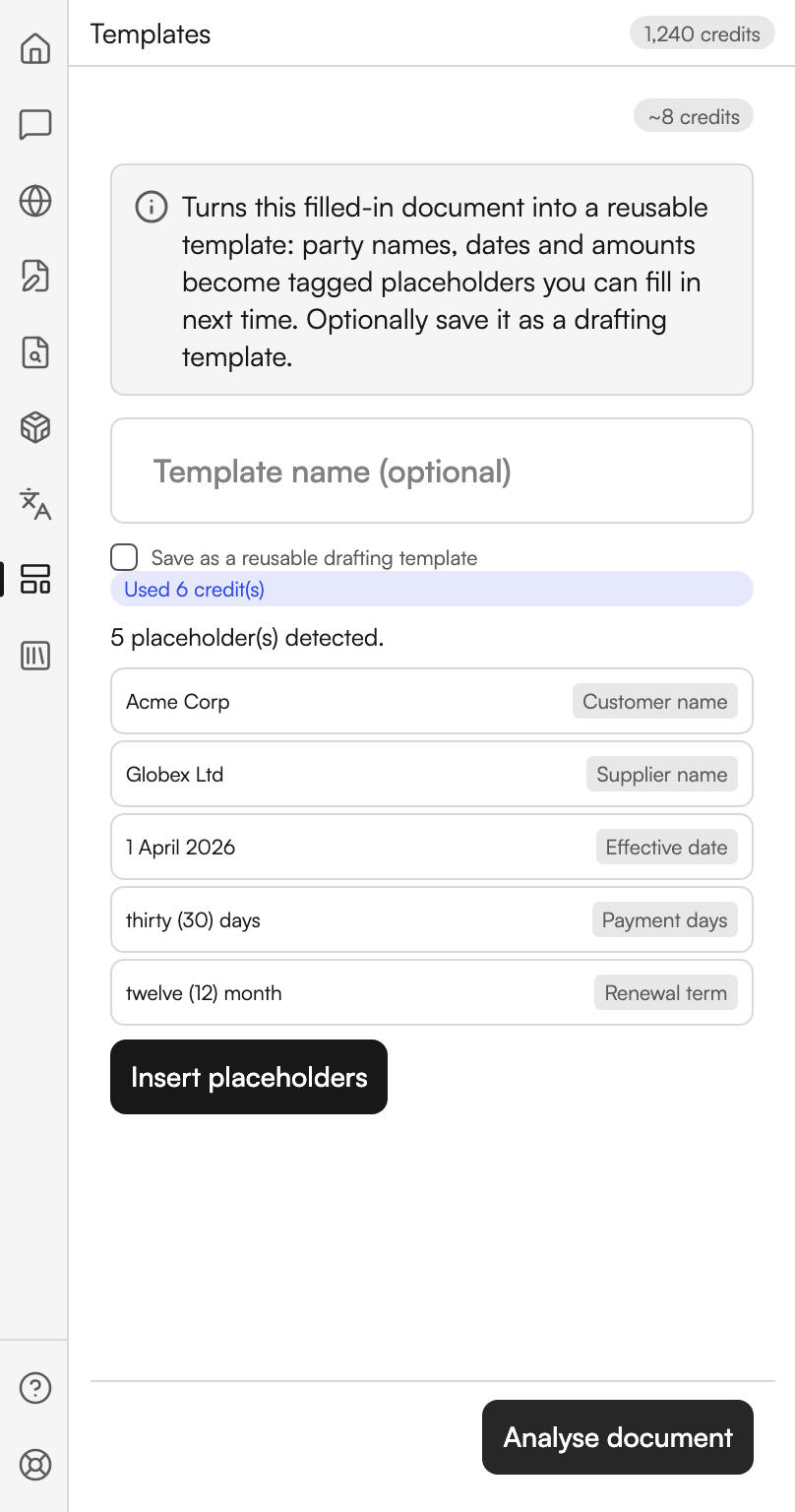
Convert to template turns a completed document into a reusable one. Its note says: Turns this filled-in document into a reusable template: party names, dates and amounts become tagged placeholders you can fill in next time. Optionally save it as a drafting template.
| Control | Where | What it does |
|---|---|---|
| The name box | Top of the panel | Placeholdered Template name (optional) |
| Save as a reusable drafting template | A checkbox below | Keeps the result as a drafting template rather than a one-off conversion |
| Only me / My organisation | A choice shown with that checkbox | Who can use the saved template |
| Analyse document | Footer | Runs the analysis and reports how many placeholders it detected |
| Insert placeholders | Under the result | Writes the placeholders into the open document |
Inserting reports how many placeholders it wrote, and names any span it could not locate in the document. On a Word version without content-control support the panel says placeholders cannot be inserted, but the template can still be analysed and saved.
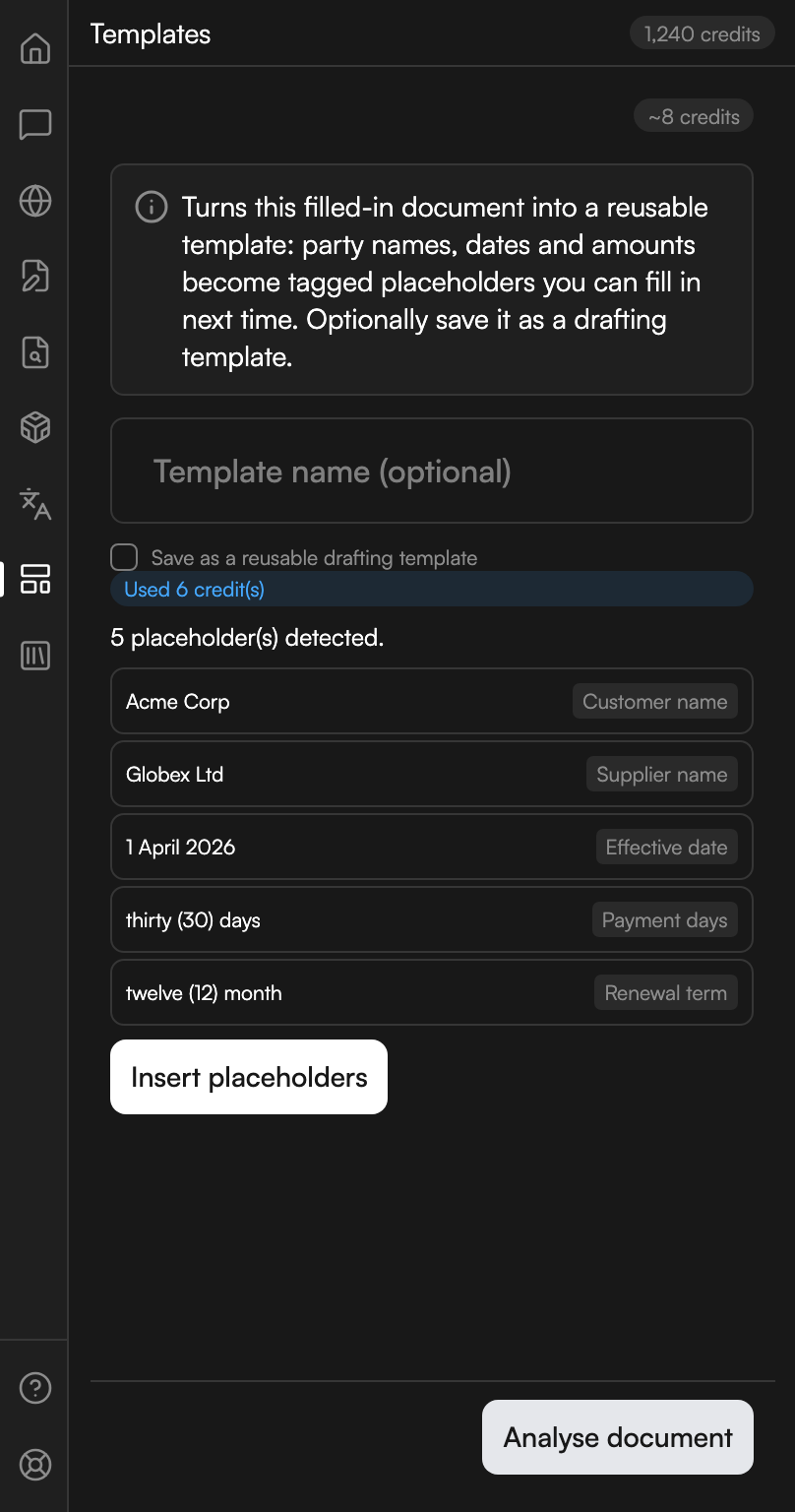
Detected placeholders
Five values found in the document, each tagged with the placeholder it would become.
File Library
File Library has two sections on a tab strip: Save and Clean copy. It opens on Save.
Save
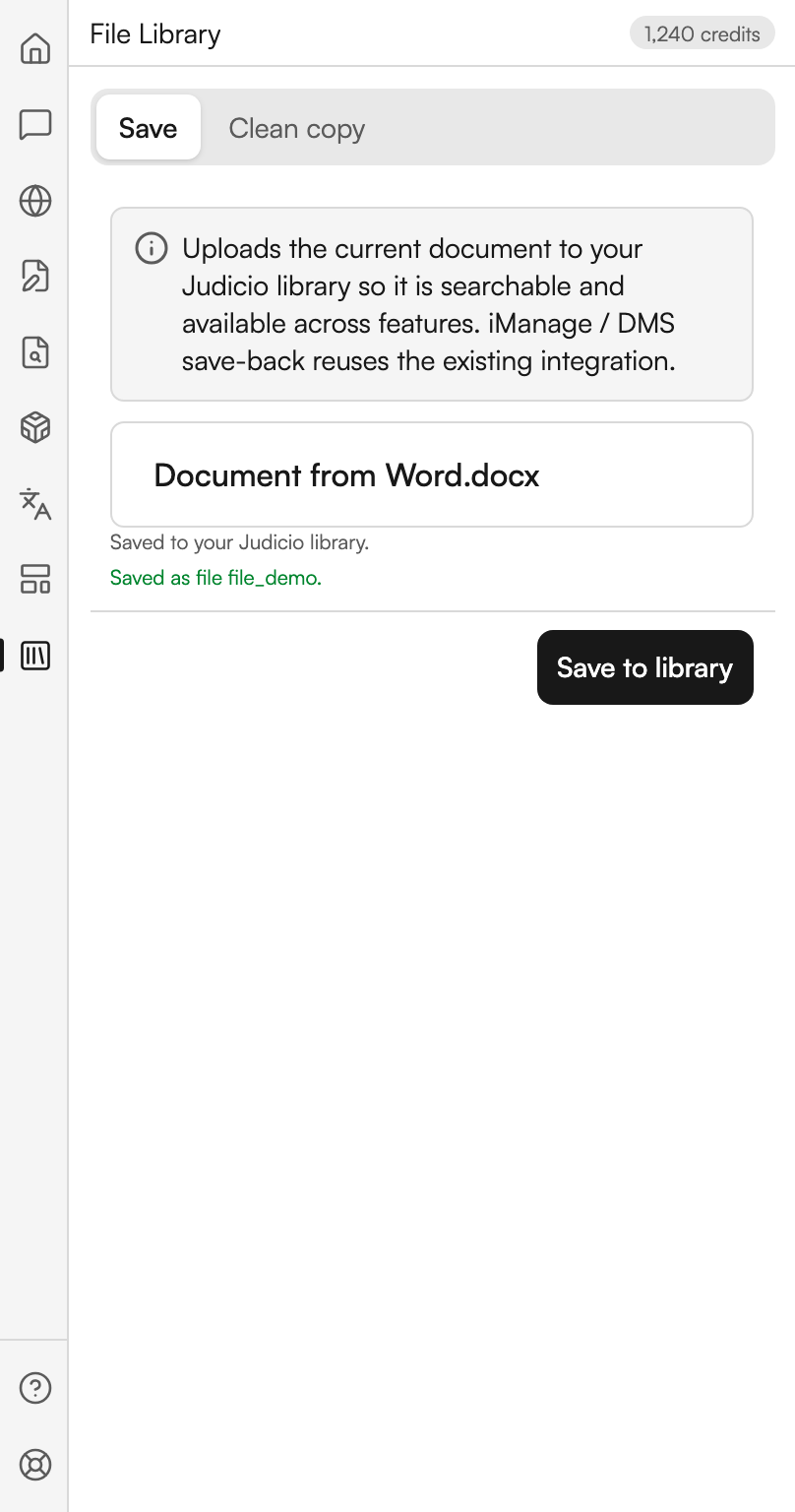
Save to Judicio pushes the open document into your library. Its note says: Uploads the current document to your Judicio library so it is searchable and available across features. iManage / DMS save-back reuses the existing integration.
Save to library in the footer runs it. The panel reports progress while it reads and uploads the file, then confirms Saved to your Judicio library. with the file's identifier.
If your deployment has no destination folder configured, the panel says so rather than running.
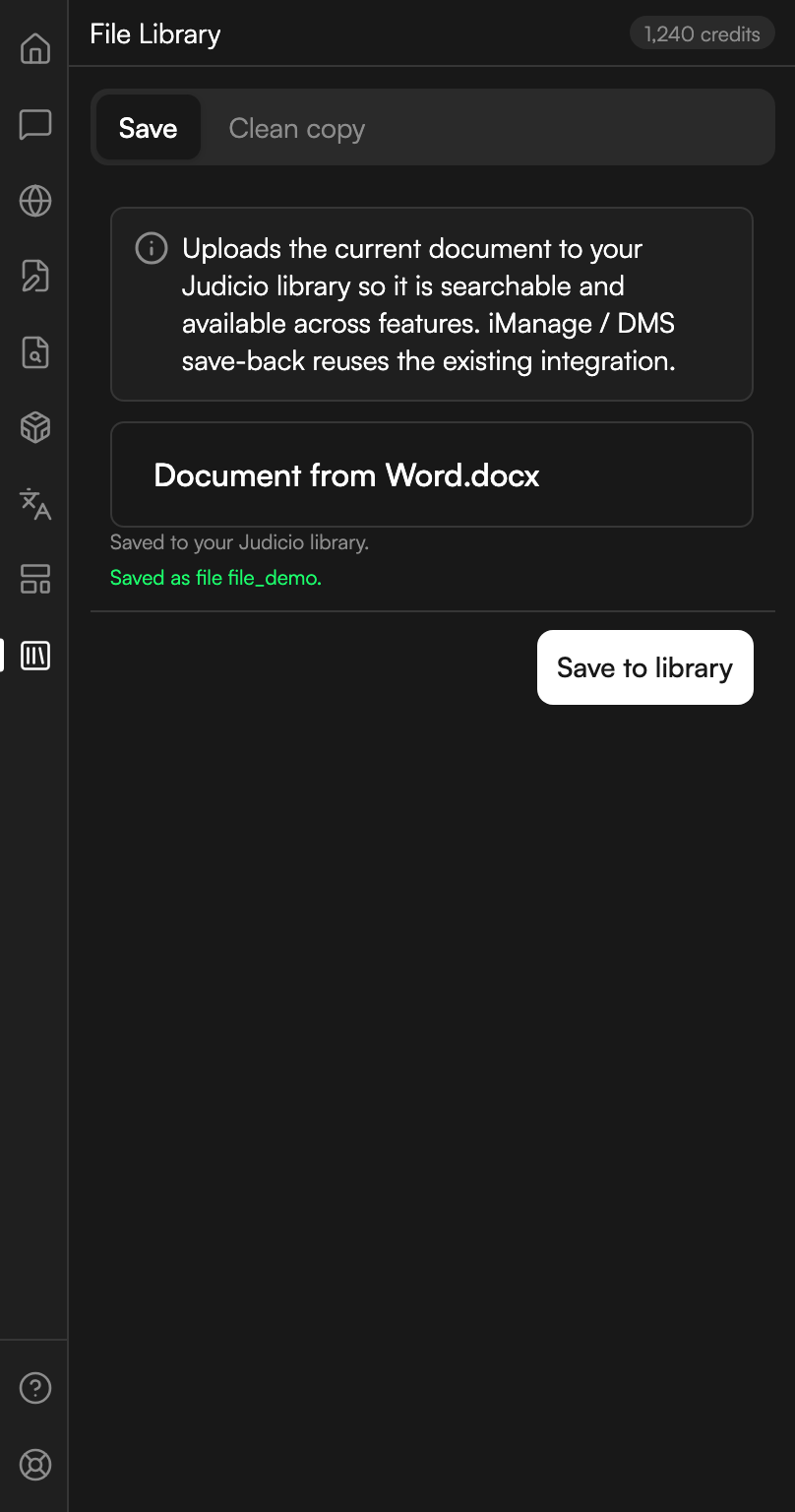
A document saved back
The open document uploaded to the library, with the confirmation under its name.
Clean copy
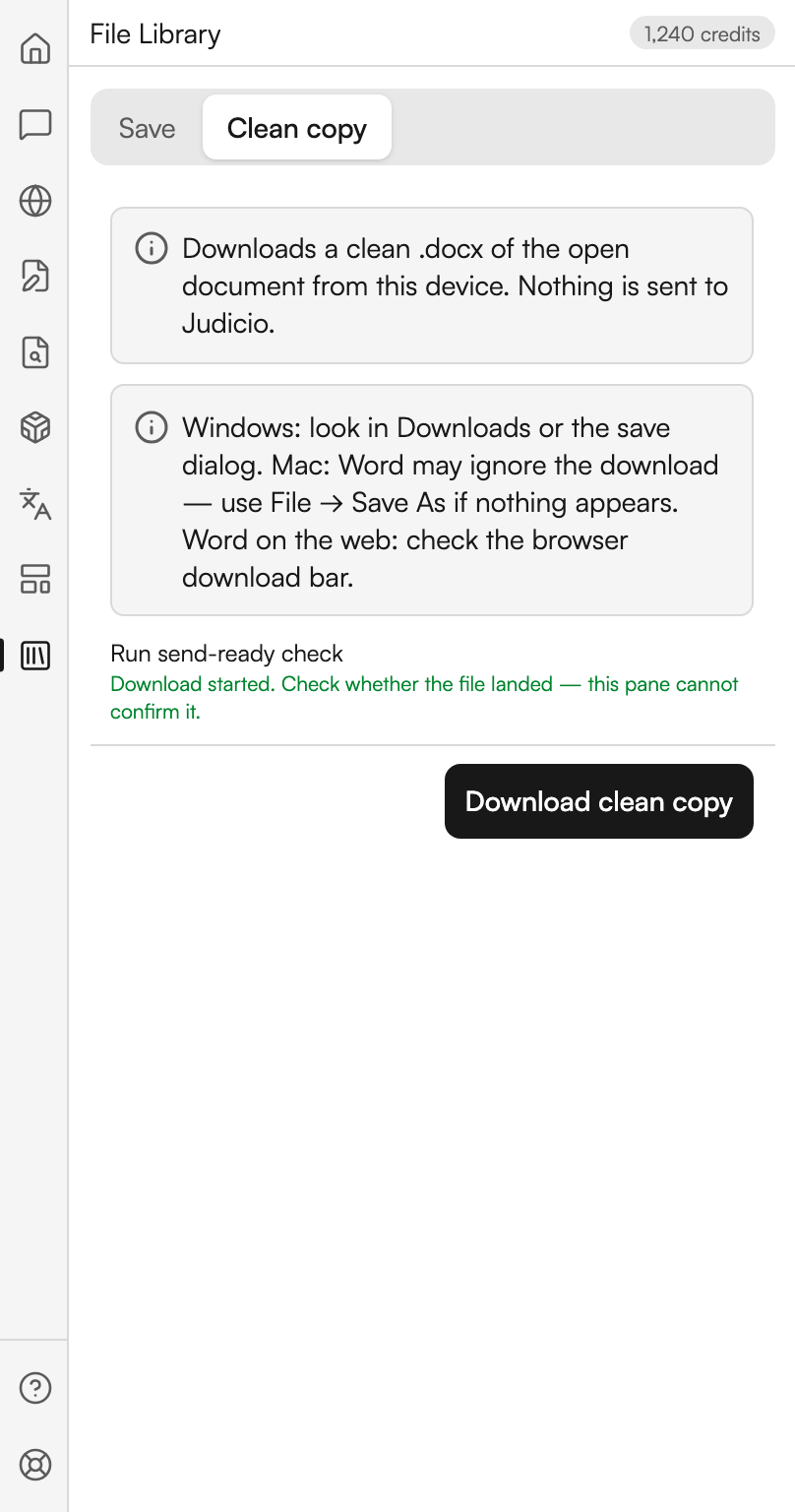
Clean copy goes the other way, and never touches the network. Its note is explicit: Downloads a clean .docx of the open document from this device. Nothing is sent to Judicio. It is free.
Download clean copy starts it. Because a task pane cannot see whether a download landed, the panel is honest about that: Download started. Check whether the file landed, this pane cannot confirm it. A second note tells you where to look on each platform. On Windows, check Downloads or the save dialog. On Mac, Word may ignore the download, so use File then Save As if nothing appears. On Word for the web, check the browser download bar.
If the host refuses to start the download at all, the panel says so.
Run send-ready check sits beside the download button and takes you to the Send-ready check, which is the right thing to run before you hand a clean copy to anyone.
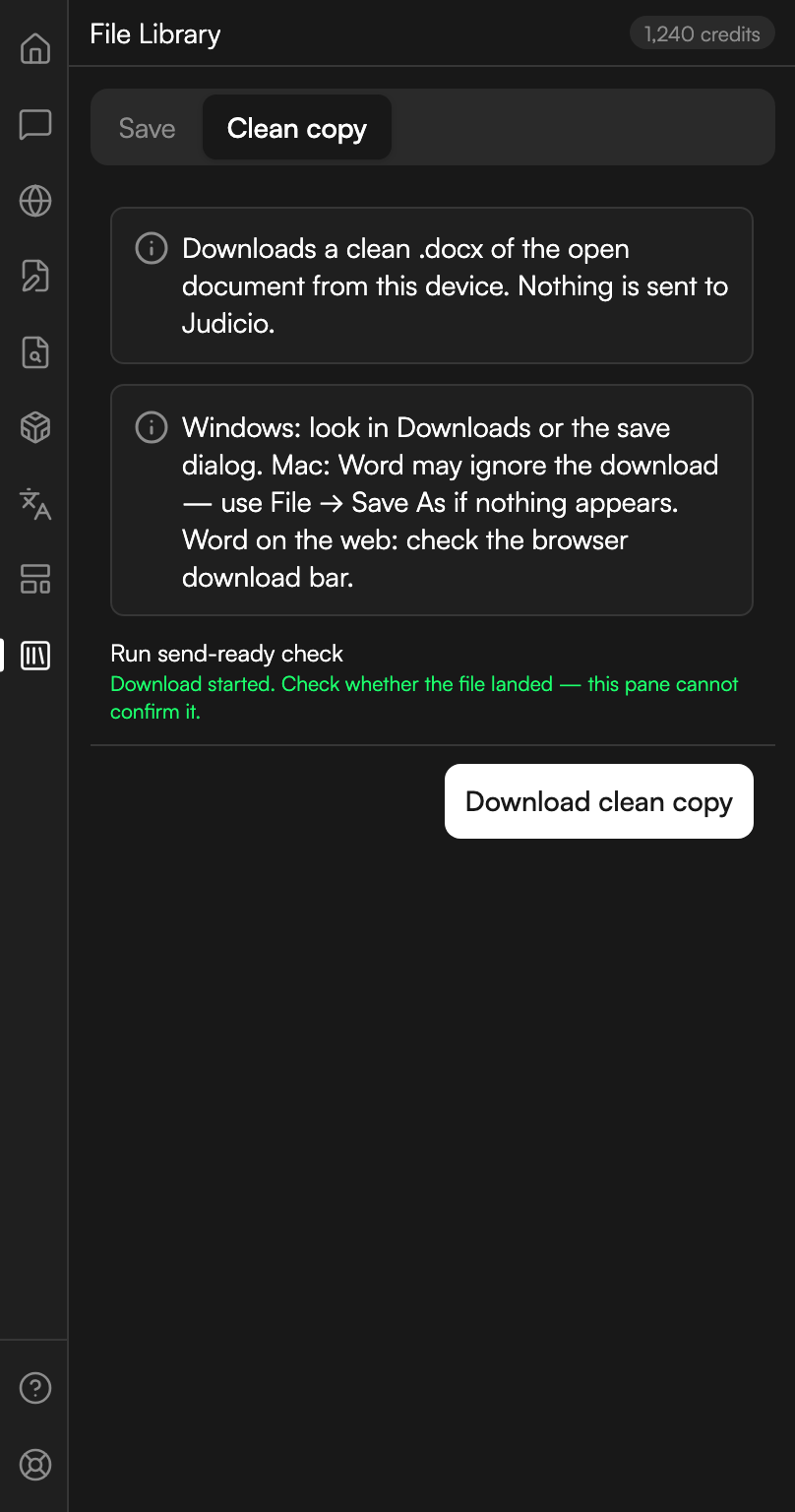
A clean copy on its way
The download started, with the note explaining why the pane cannot confirm it landed.
Where each of these is priced
Convert to template is a fixed Word action. Drafting and Translation bill at the same rate as the matching web-app feature, because they are the same runs. Save to Judicio and Clean copy are free.
The estimate chip in a charged panel's header quotes the figure before you commit, and the panel reports what the run actually cost afterwards. See Credits Explained.
Next steps
- Checks - run Send-ready check before you send the clean copy.
- The Home screen - where each of these tiles sits.
- File Library - what happens to a document once it is saved.